
Energy, Population, and Prosperity
In 1968, Stanford professor Paul Ehrlich published The Population Bomb, a neo-Malthusian book that predicted worldwide mass starvation in the near future. Ehrlich was clearly wrong, since the global population is rapidly reaching its peak and, by most accounts, is on track to then rapidly decline. But at the time, Ehrlich conjured an image that is unforgettable. He said if you extrapolate forward the population growth rates, you would eventually have a ball of human flesh expanding at the speed of light into the universe in all directions.
Ehrlich’s demographic predictions were wrong, but his metaphor remains apt. At some point, Malthusian checks do apply. If the variable of demand expands exponentially and without pause, eventually all the innovative solutions in the universe will not stretch sufficiently to meet it.
What Ehrlich never imagined, however, is that global population has not only stopped exploding but is now imploding. The only demographically significant nations left with birthrates above replacement level are in sub-Saharan Africa and portions of the Middle East and Central Asia, most notably Pakistan. And even in those nations, while in some cases birthrates remain stunningly high, they’re declining and may be on track to dip below replacement levels in a few more decades. This decline is reflected in population projections that are lowered every time they’re updated. According to some recent estimates, sometime before 2050, global population will peak at a level below 10 billion people. After that, it will drop, and nobody knows where it may stabilize.
This new global reality presents new challenges while making others easier to address. At first glance, maintaining healthy economic growth in an era of declining population while jobs are replaced by robots might seem easy. Fewer working-age humans, more robots to pick up the slack. But beneath the surface are profound unanswered questions. Can nations retain their economic vitality if their population is shrinking? There is no historical precedent for this. And who will own the robots? Who will get the jobs? What if jobs are replaced by robots faster than the working-age population declines? How will economies thrive if retirees are the majority of the population? And if some cultures—typically in poorer nations—retain demographic vitality well into the 21st century at the same time as birthrates in wealthier nations have already crashed, how will these cultures coexist?
These are the tough questions. But the challenge of finding the resources to uplift everyone in the world to a reasonable level of prosperity will be easier to address if the population stabilizes. But it will never go away.
The following table reports total and per capita energy use by region. It also shows the population in those regions—US/Canada, Russia/CIS, the Middle East, China, Europe, Asia (not including China and India), Latin America and the Caribbean, India, and Africa. The list of these geographic blocs is sorted by “GJ/pop,” that is, by per capita energy use as expressed in gigajoules (GJ) of primary energy per person.
Note the wide disparities: The US and Canada sit well ahead of the rest of the world at 269 GJ per person. Energy-rich (and cold) Russia and its satellite nations are in second place at 163 GJ per person, followed by the energy-rich (and hot) Middle East at 140 GJ per person. China at 112 already edges Europe at 105, which may come as a surprise, although Europe as a bloc includes Eastern Europe, the Balkans, and Turkey. And then there is the entire developing world: 5.1 billion people, starting with Asia (not including China and India) at only 54 GJ per person, then Latin America at 51, and India at only 27. Populous Africa, with 1.5 billion inhabitants, only averages 14 gigajoules per person per year of total primary energy. That’s one-twentieth of what Americans consume.
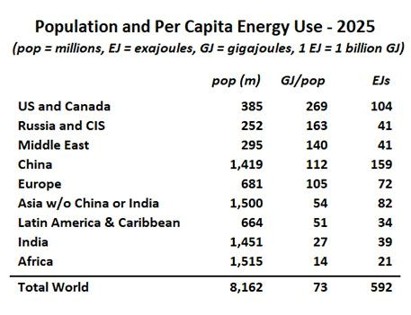
The third column on the preceding table is total exajoules. One billion gigajoules is equal to one exajoule, so where energy demographers use gigajoules to describe individual averages, energy economists use exajoules to describe national averages. As noted by the total at the bottom of column three in the above table, in 2025, total primary energy consumption worldwide was 592 exajoules.
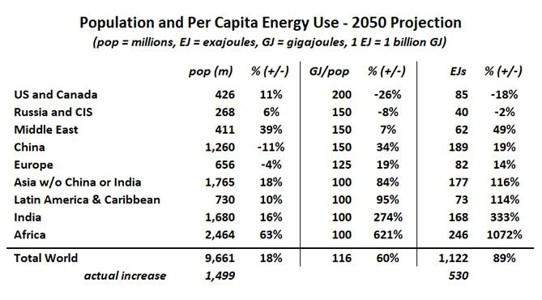
The next table, below, using the latest United Nations population projections, presents a 2050 global energy scenario that may reflect a minimum level of energy access to ensure an adequate foundation for worldwide prosperity. In the first column, 2050 population estimates are entered, reflecting current trends extrapolated over the next 25 years. The central insight to be gained from these projections is that everywhere in the world, population will either slightly decline or slightly increase, with the exception of Africa, where the population is projected to increase by 63 percent, from 1.5 billion to nearly 2.5 billion. But the next column of data, titled “GJ/pop,” or per capita energy consumption per year as expressed using gigajoules, is where our global energy future can be best understood.
Coming up with per capita energy use projections by region is speculative, of course. Who knows? But all of these estimates are aggressively minimal, which is the point. Because even if these minimums are achieved, total primary energy production in the world will have to nearly double. The third column of data, titled “EJs” or exajoules, is the product of each region’s population times its projected per capita energy consumption. As shown in the total, worldwide energy consumption in 2050 according to these projections would increase by 89 percent from 592 EJs to 1,122 EJs.
This is a low projection. Consider the assumptions: Will Americans consent to lowering their access to primary energy by 26 percent? Will the Chinese accept a per capita energy budget that is 25 percent lower than what Americans still enjoy? And will the rest of the nations in Asia, Latin America, and Africa accept access to primary energy that is at only half the per capita amount that Americans get? But nonetheless, these calculations indicate that in just 25 years, global energy production needs to nearly double in order to achieve just a minimal degree of universal energy security in the world.
These numbers constitute a case for why an all-of-the-above energy strategy is the only practical option. They support the case for retaining and expanding the role of fossil fuels while at the same time aggressively developing every sort of emerging alternative energy technology. But critics of this reasoning point to what they call the “primary energy fallacy.” The critics argue that better energy efficiency will make it possible to deliver universal energy security without increasing global energy supply. By their reasoning, it is therefore possible over the next 25 years not to increase overall energy production, but to merely replace fossil fuel with “clean” energy at a one-to-one rate. This merits further discussion. The concept is valid. But the numbers won’t work.
Throughout this analysis, the term “primary energy” has been used. This refers to the raw fuel—crude oil, methane, coal, nuclear, wind, solar, hydro, geothermal, and biomass—before it has been mined, refined, transported, or converted into electricity and transmitted, and then processed by an end-user device: an automobile’s horsepower, an airplane engine’s thrust, a light, a heater or air conditioner, any appliance, a computer, or a transmitter, etc.
An interesting way to visualize the flow of global energy from raw fuel into end-user services comes from the Lawrence Livermore Laboratory. What these flow charts reveal is that only about one-third of primary energy is actually realized in end-user energy services. The rest is “rejected energy,” lost in extraction and processing, power generation, heat, friction, transit losses, and inefficient conversion at the point of end use, such as a gasoline engine that typically only converts around 25 percent of the energy in the gasoline into actual horsepower.
The fact that, on average, roughly two-thirds of the energy embodied in primary fuels is wasted does present a tremendous opportunity. If, for example, the ratios were flipped through innovations that delivered far greater conversion efficiency, so that two-thirds of raw fuel inputs were realized in end-user services and only one-third was wasted, total primary energy production wouldn’t have to increase at all to achieve our 2050 projections. But this is a fantasy.
While future technologies promise to deliver much better improvements in efficiency, getting to only 50 percent waste would still be an ambitious target. If so, total world production of primary energy would have to rise to 748 EJs, an increase of 26 percent over today’s levels. This is still a fantasy, because end-user demand is going to increase. The automation of virtually everything is coming, and setting aside the dystopian variants for a moment, that automation is going to require a lot of power at every level of the industrial process, from mining, refining, and transporting the materials to charging and operating the myriad devices.
Nine billion people with nine billion robots. That number isn’t a stretch if you define “robot” as every android in the world, alongside every vehicle, every passenger drone or delivery drone, every airplane and spaceplane, every robotic surgeon, automated agricultural machine, manufacturing robot, and so on. They’re coming, and they’re going to need a lot of juice. It’s easy to get tangled up in numbers here, but the algebra is nonetheless straightforward. Assume worldwide available end-user energy per capita isn’t going to increase by a mere 60 percent between 2025 and 2050 in order to deliver at least the possibility of worldwide prosperity and peace. Increase it instead by 100 percent to take into account all the automation and all the aspirations of humanity from Indonesia to Africa. Plug in that assumption, and even at a 50 percent worldwide conversion efficiency, we’re almost back to our original estimate: these assumptions equate to a total worldwide raw energy requirement of 935 EJs by 2050, a 67 percent increase over where we are today.
Energy is the foundation of material prosperity. With abundant energy, every other physical process becomes feasible, and without it they are impossible. From desalinating hundreds of millions of acre-feet of seawater per year to powering the burgeoning electric age that is upon us, abundant energy is a prerequisite. Successfully achieving abundant energy first requires being realistic about how much we are going to need. To do that, wading through the numbers may be tedious, but the conclusion they all point to is indisputable. In the foreseeable future, we need all the energy we can get, from every source we can imagine.
In a world where scientists and engineers are free to innovate, and entrepreneurs and investors are free to compete, these targets will be achieved. From a pure engineering standpoint, the streams of energy technologies are too diverse and too promising to justify pessimism. And our reasons for optimism are compounded by the fact that we didn’t turn into that proverbial ball of human flesh expanding exponentially. The likely appetite of humanity for energy is bounded by a population that has stabilized. The only cause for alarm that we must mitigate is political, not technical, and that challenge is very real.
This article originally appeared in American Greatness.
Edward Ring is the director of water and energy policy for the California Policy Center, which he co-founded in 2013. Ring is the author of several books, including The Abundance Choice – Our Fight for More Water in California (2022), and The Analyst’s Cookbook: Making the Case for Abundance Using Numbers (2026).