Published May 15, 2026
Published May 15, 2026
The charter school movement emerged in the early 1990s in response to growing dissatisfaction with the traditional public school system and a desire to give parents greater control over their children’s education. Under the charter model, schools are publicly funded but operate independently of district bureaucracies — and in most cases, independent of teachers’ unions. This structure gives charter schools greater flexibility in curriculum, staffing, and operations, while still holding them accountable for academic performance.
In California, the charter school boom ignited a political fight led by the teachers’ unions. They see charters not as an innovation but as a threat to their power, funding, and membership. In response, the unions have launched a decades-long campaign against charters by employing legislation, lawsuits, school board takeovers, union organizing campaigns, and political pressure to stifle the competition. Despite these efforts, California charter schools have survived and thrived, growing significantly from their 1990s levels.
Research continues to show that California’s urban charter schools, especially those enrolling low-income and minority students, consistently outperform traditional public schools in areas like math and reading achievement scores.
In 1992, California Governor Pete Wilson signed SB 1448, implementing California’s public charter school law and establishing California as the second state to legalize charter schools after Minnesota. While charter schools were introduced in California to promote innovation and flexibility within a rigid public school system, they also served as a way to retain families who might otherwise have left for private schools or voucher programs.
The unions did not want to allow public funding to follow students to alternative schooling options, something that was threatened by Proposition 174 in 1993, a failed statewide initiative that would have provided parents with taxpayer-funded vouchers for private school tuition.
At the same time, the teachers’ unions argued that charter schools would weaken collective bargaining rights, and lobbied aggressively to defeat SB 1448 while pushing for an alternative AB 2585. Authored by Assemblymember Delaine Eastin, the Chair of the Assembly Education Committee, AB 2585 would have kept charter school teachers in existing collective-bargaining units (Governor Wilson later vetoed Eastin’s proposal).
In an attempt to create a compromise, the author of SB 1448, Senator Gary Hart (D), included a provision in the bill that required new charter schools to obtain a specific number of teacher signatures before a local governing board could approve them.
The provision failed to appease the teachers’ unions and simultaneously hardened opposition from other school employee unions because the unions were explicitly excluded from any say in how charter schools were developed. By requiring individual teachers to sign charter petitions, the unions argued it shifted authority away from them, cutting unions out of the approval process and weakening their influence over labor conditions and the direction of charter school growth.
Despite this intense pushback from labor groups, the bill moved through the legislature with unexpected speed, preventing the unions from mounting a successful campaign to block it. In a 2018 interview with EdSource, retired Senator Hart acknowledged that SB 1448 only passed because supporters rushed it through before unions had time to organize opposition.
The Unions’ Arguments
Since California’s first charter schools opened their doors in the fall of 1993, they have consistently increased enrollment. In 1998, Assembly Bill 544 raised the initial cap of 100 charter schools to a new limit of 250 for the 1998–99 school year and authorized the addition of 100 new charters each year thereafter.
But as charter schools grew, the teachers’ unions ramped up their opposition. They saw the existence of charter schools as a threat for several reasons.
Teachers’ unions argued that charter schools divert essential funding from public schools because state educational funding is based on Average Daily Attendance (ADA), meaning districts receive less funding when students leave for charter schools.
Unions also opposed charter schools because they are exempt from many state and district regulations applied to traditional public schools, which they claimed weakened accountability.
Above all, unions saw charter schools as a direct threat to their financial base. Because charters typically employ a smaller percentage of unionized staff and often operate outside of district-wide collective bargaining agreements, they represent a significant loss in potential dues. Unions further contended this would reduce their collective bargaining power.
The most recent charter-sector data available from the National Alliance for Public Charter Schools found that only 10.4 percent of charter schools had collective bargaining agreements in 2018-19. By contrast, NCES reported that roughly 70 percent of public school teachers nationally, and more than 90 percent of California public school teachers, belonged to a union or similar employee association in its 2017-18 survey. While this data is slightly dated, available evidence continues to show a large unionization gap between charter schools and the broader public school system. For example, in 2026, only one of the approximately 50 operating charters is unionized in Orange County, according to Orange County Board of Education President Mari Barke.
However, the unions’ characterization that charter schools would operate outside of sufficient oversight was inaccurate. In fact, charter schools remained subject to a wide range of state and local regulations, including requirements related to facilities, funding, and student performance. Rather than operating without rules, charters were designed to trade certain bureaucratic constraints for greater flexibility in areas such as curriculum, instructional methods, and school management. Supporters argued that this flexibility allowed charter schools to innovate and respond more effectively to student needs while still holding them accountable for results.
The unions countered charter growth by championing a wave of new regulations framed as “common-sense” accountability measures. By leading the charge on several legislative fronts, they sought to use administrative oversight as a tool to slow the movement’s momentum.
In 2001, the California Legislature passed SB 740, which was a significant blow to “nonclassroom-based” (NCB) charters. Previously, a charter school could receive public funding based on average daily attendance, even if the students were mostly not being taught in a traditional classroom setting.
SB 740 changed that by requiring charter schools offering nonclassroom-based instruction to obtain a funding determination from the State Board of Education before receiving state funding for that attendance.
Opponents of the bill argued that SB 740’s rigid spending mandates threatened the survival of small, innovative charters. The law created a deep rift within the charter community by targeting NCB schools with unique administrative burdens, leading to disproportionate fiscal strain. By failing to account for essential costs like facilities and emergency reserves, the law artificially inflated school operating costs. A study in 2005 from RAND found that the bill had prompted NCBs to pay more attention to resource allocation.
However, the study also found that while SB 740 successfully increased instructional spending, its initial implementation caused significant administrative burdens and fiscal instability for NCB schools, potentially stifling innovation and placing some programs in financial jeopardy.
In 2002, the California Legislature passed AB 1994, imposing stricter financial, geographic, and administrative regulations on charter schools. The new regulations required charter schools to operate within their authorizing district or county, submit annual financial reports, and comply with county superintendent oversight, while also limiting growth by allowing only one school per charter petition.
Forcing charters to operate within district or county boundaries gave local school boards — often union-backed — greater control over charter approvals and denials. Likewise, the monitoring authority given to superintendents made it easier to regulate and restrict charter operations.
By requiring charters to submit annual financial reports, unions gained a tool to attack charters over exaggerated concerns about financial mismanagement. Many new charter schools start with limited reserves due to the significant startup costs for new schools and much lower per-pupil funding for charters than their traditional public school counterparts. As a result, if enrollment falls short or early funding runs out, charter schools often run deficits in their first three years. While this early financial strain is a predictable feature of new schools rather than evidence of mismanagement, unions have often exploited this reality to portray charters as financially irresponsible.
In 2003, the legislature passed the union-backed AB 1137, fundamentally shifting charter oversight from local missions to state-mandated bureaucracy. While the original 1992 Act already required performance-based renewals, it allowed for localized flexibility. AB 1137 replaced this autonomy with rigid Academic Performance Index (API) benchmarks and mandatory annual site visits.
Labor unions framed the bill as a “quality control” measure, using a few low-performing schools to justify a sweeping expansion of state power. In practice, however, these complex new requirements functioned as “procedural trapdoors.” They provided hostile, union-aligned school boards with the legal ammunition to deny renewals based on technicalities rather than actual student outcomes.
The Thomas B. Fordham Institute warned that this shift threatened to stifle innovation by forcing schools to prioritize standardized testing over unique educational models. Ultimately, AB 1137 was less about raising academic standards and more about weaponizing regulation. Since most charters were generally attaining similar or comparable academic results to traditional public schools, the bill served primarily to keep the charter movement in a state of constant legal vulnerability.
Union Opposition in Local School Board Battles and Legal Challenges
In the early 2000s, the teachers’ unions, including the California Teachers Association (CTA) and the California Federation of Teachers (CFT), took the fight to local school boards by actively funding the political campaigns of school board candidates aligned with the unions’ opposition to charter expansion.
The unions’ strategy had a decisive effect. A research study from Boston College investigated how teachers’ unions are highly influential in local politics. The study found that during the years 1998-2002, the unions were extremely effective at getting their favored candidates elected. Further, the data showed that the candidates did not win because they were stronger candidates but because of the union support.
Overall, 76 percent of California candidates endorsed by unions won, including 62 percent of challengers and 92 percent of incumbents. The same study found that union endorsement was as effective as incumbency in its power to predict a candidate’s win.
By targeting school board elections, the unions sought to control the decision-makers directly involved in charter school approvals and oversight. In many districts, unions succeeded in keeping decision-making regarding charters in the hands of elected school board trustees beholden to the union.
Despite new regulations and growing union influence over local school boards, charter schools continued to expand rapidly throughout the early 2000s.
Between the 1999-2000 and 2009-10 school years, California’s charter sector grew from 238 to 813 schools, while enrollment rose by nearly 212,000 students.
For example, in Oakland, the number of charter schools in the city more than tripled during the decade. Much of the growth was driven by district superintendents who supported charter-friendly policies.
Oakland’s charter school expansion was significantly bolstered by the city’s then-mayor, Jerry Brown. A strong advocate for educational competition and parental choice, Brown helped establish two high-profile charter schools: the Oakland Military Institute and the Oakland School for the Arts (OSA).
In the case of the Oakland Military Institute, Brown pushed past local resistance after both Oakland Unified and the Alameda County Office of Education rejected the proposal, ultimately securing approval from the State Board of Education. As a prominent Democrat and former (and future) governor, Brown’s involvement showed that charter advocacy was not confined to party lines, even as opposition to charters was growing within organized labor and parts of the Democratic coalition.
More broadly, much of the charter expansion was fueled by grassroots organizers, while many others were opened through charter management organizations. As charter schools expanded and proved successful, parents flocked to these more innovative options. This growth was driven by a new variety of charter educational models, including high-achieving academic hubs, theater arts schools, and specialized immersion programs that catered to the diverse interests of California’s student population. Teachers unions responded by increasing their political and legal attacks on charter schools.
As these conflicts moved from legislative fights to local boardrooms and courtrooms, charter advocates began building the legal infrastructure needed to defend schools after they were approved. In 2003, the California Charter Schools Association (CCSA) began organizing legal support for charter schools facing hostile authorizers, facilities disputes, and other challenges. That legal strategy soon became central to the charter movement, as fights over approval and access to public school facilities became one of the main ways districts and unions could slow charter growth.
A high-profile legal clash over charters occurred in 2003, when the Los Altos School District Board of Trustees turned down the petition for Bullis Charter School (BCS) in Santa Clara County. The district claimed the proposal lacked focus, had weak planning, and did not show enough legal knowledge, financial stability, or a solid facility plan.
The local community paper, Los Altos Town Crier, wrote, “District officials see this as money lost, although the law disallows them from using lost funding as a reason to deny a charter. Still, it remains obvious that the district’s teachers’ union and many parents oppose the charter for this reason.”
After the district’s rejection, the Santa Clara County Board of Education approved Bullis Charter School on September 10, 2003. Less than a month later, the Los Altos board voted to allow the county to oversee the school while accepting responsibility for providing its facilities. Bullis opened in August 2004 after months of conflict.
The facilities fight continued for years, with Bullis repeatedly arguing that the district’s offers were not “reasonably equivalent” under Proposition 39. After several early rulings favored the district, Bullis won a major appellate victory in 2011 when the Sixth District Court of Appeal found that the district’s 2009-10 facilities offer did “not comply with Proposition 39 or its implementing regulations.” The California Supreme Court denied review in January 2012, leaving the appellate ruling in place, and the Superior Court later ordered the district to amend its facilities offer to make it legally compliant.
The Bullis dispute became one of the clearest examples of how facility access could be used to slow or constrain charter growth. While the courts ultimately sided with Bullis, the conflict was not an isolated local spat. It foreshadowed a broader pattern in which charter opponents used facilities disputes, administrative process, and litigation to limit charter growth.
A nearly identical struggle played out simultaneously in Southern California. In 2007, the CCSA sued the Los Angeles Unified School District (LAUSD) over its refusal to fairly distribute facilities. At the time, the LAUSD board was dominated by union-backed members who prioritized protecting the territory of traditional schools over the legal rights of charter students. After eight years of back-and-forth rulings, the California Supreme Court again intervened in 2015, finding that LAUSD—like Los Altos before it—had failed to act in accordance with Proposition 39.
Together, these cases illustrate a systemic “facilities war” where districts used litigation as a weapon of first resort.
As the decade progressed, the CTA increasingly found itself on the defensive. Charter schools, once considered a niche experiment, were growing rapidly as they tripled in California enrollment, drawing families in droves from traditional public schools despite these orchestrated hurdles.
The scale of this shift was historic. According to data from the California Department of Education and the National Alliance for Public Charter Schools, the growth during this period looks as follows:
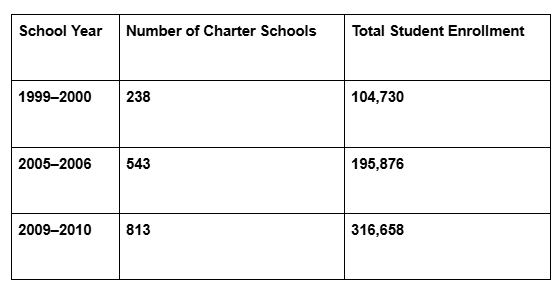
By 2010, the “niche experiment” had become a permanent and formidable pillar of the California education landscape, setting the stage for the high-stakes legislative and legal battles that would follow through the next decade.
During 2010–11, California ranked first in the nation in charter school attendance, with 364,000 pupils. With public funds shifting from unionized traditional public schools to charters, teachers’ unions accelerated their anti-charter resistance. By 2013, the CTA was actively looking for new ways to restrict charter school growth, including proposals to limit charter access to district facilities and impose new governance, disclosure mandates, and performance audit requirements. In their campaign to constrain charters, teachers’ unions led the charge in pushing an onslaught of anti-charter legislation.
Examples include the following:
While many of these bills died in committee, they forced charter advocates to spend precious time and resources on defense, successfully signaling that any further expansion would be met with legislative resistance.
In 2010, charter school activists achieved a significant victory by helping California become the first state to enact a “Parent Trigger” law signed by Governor Arnold Schwarzenegger. Known officially as the Parent Empowerment Act, the law enabled parents to force reform in underperforming traditional public schools that failed to live up to certain academic requirements. Under the law, if 50 percent of parents, plus one, at a failing school signed a petition, they had an option of numerous intervention methods, such as transforming the school into a charter school, changing the principal and teachers, adding new programs, or shutting down the school.
The new law sparked a rare grassroots coalition in support of charter schools across political, racial, and socioeconomic lines. As the bill’s author, Senator Gloria Romero, then Democrat and former Senate Majority Leader, later explained in an interview about the law:
“In California, for example, it was very interesting to see people come together. And this wasn’t on a partisan basis; it wasn’t about Republicans or Democrats. People didn’t even ask each other about their political persuasions. They asked about the quality of their kids’ education and whether or not their kids were better off now than when they first entered their school, and most of the time, the answer was no. We found it was a time to coalesce with business owners, faith-based communities, churches, and community groups to really move this forward.”
But Romero also recognized the entrenched resistance from the unions, stating, “Too often elected officials are afraid to take on powerful special interests, like teachers’ unions, who fear that they may lose control of basically calling the shots in an education system when parents begin to have a greater voice. I think that’s a good thing, and I don’t think we should be afraid of that.”
Unsurprisingly, California’s two major teachers’ unions, the California Federation of Teachers (CFT) and the CTA, fought hard against the law. Marty Hittelman, then-president of the California Federation of Teachers, faced backlash after he called the Parent Trigger law a “lynch mob provision.”
Once the law took effect, the first school to successfully use it was Desert Trails Elementary School in Adelanto, California, which was transformed into Desert Trails Prep after gathering sufficient parent support.
By 2015, the Parent Trigger law had been invoked at several sites across California, though its impact was felt more through negotiated reform than full-scale takeovers. “While Desert Trails Elementary in Adelanto was, at that point, the only school fully converted into a charter through the law, the ‘trigger’ was used at several other schools to force varying degrees of change.” Schools such as West Athens Elementary and Lennox Middle School leveraged the law to negotiate changes with existing school and district leaders. At 24th Street Elementary in Los Angeles, parents used the law’s leverage to secure a hybrid district-charter model, with the district running the lower grades and a charter partner operating the upper-grade program.
Proponents argue that the law’s success should not be judged by conversion counts alone, but by its ability to act as a catalyst for action. In many cases, the mere circulation of a petition compelled districts to replace unpopular principals or implement new academic programs to avoid a total charter transition. However, this “leverage” model was short-lived, as union-led opposition eventually targeted the very metrics that made the petitions legally valid.
Teachers unions opposed the Parent Trigger law and viewed it as a vehicle for corporate-backed privatization of public education under the guise of parent empowerment. They fought the law and the parents who used it at every turn.
When schools in Los Angeles, like Weigand Elementary, considered the use of the Parent Trigger law, union activists led protests against it. United Teachers Los Angeles (UTLA) was particularly alarmed that many of the schools eligible for reform under the law were located in Los Angeles. The Contra Costa Times reported that UTLA put significant effort into fighting the Parent Trigger law, even voting to recruit a legislator to sponsor a bill that would “reform” the law. The Contra Costa Times wrote, “The union represents 35,000 Los Angeles educators, and though statewide teachers’ unions have taken the lead in the fight against the parent trigger in the past, UTLA is prepared to take up the cause on its own.”
One of the hardest-fought victories in the history of the Parent Empowerment Act occurred at Palm Lane Elementary in Anaheim. In 2015, parents at the school successfully submitted a petition to convert the campus into an independent charter school. The move followed years of the school being ranked in the bottom 5 percent of California’s academic performance indices.
The transition, however, was anything but smooth. The Anaheim City School District challenged the validity of the petition signatures, leading to a protracted legal battle that lasted over two years. The opposition from labor groups and the district was immense, involving millions of dollars in legal fees and administrative pushback.
Despite this intense pressure, the families of Palm Lane prevailed. In 2017, an appellate court upheld the parents’ right to convert the school, marking a significant win for the parent-led movement. This victory was particularly poignant as it occurred just as the state’s shift toward the “California School Dashboard” began to render the Parent Trigger law functionally dormant.
Through persistent opposition and political pressure, teachers’ unions helped weaken the Parent Trigger law’s practical effect. The law became increasingly difficult to use after California moved away from the API and Adequate Yearly Progress accountability systems on which the law depended. Those systems were replaced by the California School Dashboard, a broader accountability framework adopted through actions by the California State Board of Education and the California Department of Education. The move was praised by the CTA. CTA President Eric Heins said, “While the Dashboard is still a work in progress, this system is much improved from the old shame-and-blame accountability system, and the days when districts, schools, and students were judged heavily on a single test score.”
The Dashboard’s expanded set of metrics, such as chronic absenteeism and suspension rates, made it harder to clearly define what qualified as an “underperforming” school. As a result, the Parent Trigger law became difficult to apply. On June 20, 2019, the California Department of Education officially removed the Parent Empowerment program from its administration (the underlying statutes technically remain in the law, though they are currently “dormant” due to the lack of a qualifying accountability metric).
Despite the unions’ efforts, charter schools continued to grow in both popularity and numbers. The unions then began prioritizing a different approach: unionizing teachers within charter schools.
Internal CTA discussions, reported by teachers’ union expert Mike Antonucci, revealed a clear strategy to make the perceived harm of charter schools more visible.
Internally, the CTA moved to produce promotional materials and workshops titled “How to Unionize Charter School Teachers,” seeking to bring these educators into the fold. At the same time, union leadership aggressively lobbied to undermine the charter model by proposing performance audits, seeking to revoke charter access to surplus school property, and attempting to isolate charter funding into a separate, more vulnerable appropriations source.
Union leaders argued these aggressive measures were necessary to make the “harmful impact of charter schools” more “transparent” to the public. By having its internal assembly of traditional teachers vote on anti-charter resolutions, the CTA manufactured a narrative of “teacher disapproval” to bolster its lobbying efforts in Sacramento. This created a strategic paradox: leadership was using the votes of teachers to undermine the charter model while simultaneously trying to convince charter educators to join the union for protection.
In 2014, building on earlier efforts, teachers’ unions made it a central part of their long-term strategy to unionize charter school teachers and bring those schools under union control. Then-President-elect Lily Eskelsen García of the National Education Association (NEA), the parent organization to the CTA, visited a unionized charter school in Alameda, California, to spotlight the union’s growing focus on organizing charter school teachers. The visit marked a shift in strategy as the NEA and its California affiliate began prioritizing union efforts within the largely non-unionized charter sector.
In March of 2015, nearly 70 teachers and counselors at Alliance College-Ready Public Schools, then Los Angeles’ largest charter school network, sent a letter to school leaders, notifying them of their intention to partner with UTLA to form a union. Alliance management resisted the campaign, triggering years of disputes before courts and the California Public Employment Relations Board over alleged anti-union tactics.
UTLA filed unfair practice charges accusing Alliance of interfering with the organizing effort, while Alliance argued that the union could not organize the network school by school. In 2020, PERB ruled that UTLA had demonstrated majority support at three Alliance schools and certified the union as the exclusive representative for those employees, rejecting Alliance’s argument that only a network-wide bargaining unit was appropriate. The 2015 campaign therefore marked a major escalation in union efforts to organize large charter management organizations in Los Angeles.
The union’s momentum continued in 2016, when PERB recognized a single bargaining unit for teachers across California Virtual Academies (CAVA), the state’s largest online charter network. This was a landmark victory for the CTA, proving that unionization could penetrate even the nontraditional, virtual charter sector.
But not all charter unionization campaigns produced lasting victories for the unions. In 2018, the 1,300-student Gompers Preparatory Academy unionized, with its staff joining the 7,000 members of the San Diego Education Association. Once unionized, however, the school experienced significant internal strife, including years of legal battles over labor practices and contract agreements.
By 2021, disaffected Gompers teachers attempted to oust the union, but narrowly failed. They eventually succeeded in 2023, voting to decertify the union. Mark Mix, whose National Right to Work Legal Defense Foundation assisted the Gompers teachers, framed the vote as a moment of clarity for the staff. According to Mix, the outcome demonstrated a growing consensus among the educators that the union’s presence failed to serve the community’s best interests.
Overall, the CTA found it difficult to unionize charter schools across the state. While some charters were successfully organized, many schools remained resistant, and the union’s campaign ultimately saw varied success.
Today, the CCSA estimates that about 30 percent of charter schools in California have some form of a collective bargaining agreement or representation. This figure remains significantly higher than the national average of around 11 percent.
By 2015, teachers’ unions were going all-in on local school board elections. They backed school board candidates who opposed charter schools and poured millions into races across the state. Los Angeles, Oakland, and San Diego saw some of the biggest spending as unions worked to install anti-charter majorities on district school boards.
Los Angeles was a key focus because it had become the largest charter school market in the country. Oakland was not far behind, with one of the highest percentages of students enrolled in charter schools. Gaining control in these districts was not just about local power. It offered unions a chance to steer state education policy and influence the broader conversation about charter schools across the country.
During the 2015 elections for LAUSD school board, pro-charter advocates faced off against UTLA, with both groups pouring hundreds of thousands of dollars into campaigns for their preferred candidate. The pro-charter candidate, Ref Rodriguez, won over the incumbent Bennett Kayser. Rodriguez’s win gave charter advocates an important foothold on the board, but it did not overturn the broader union-aligned majority at LAUSD.
The battle over charter schools soon expanded beyond Los Angeles into the broader 2016 election cycle. Teachers unions and charter advocates accused each other of attempting to buy influence in school board and statewide races. The unions cried foul, decrying that charter advocates, wealthy billionaires, and “special interests” poured $24 million into races in 2016. Meanwhile, the California Policy Center reported that teachers’ unions spent over $27 million on statewide races during the same 2016 election cycle, with actual spending being much higher due to a lack of available contribution data from the secretary of state on school board candidates and other local campaigns.
In the 2016 Oakland school board election, all four incumbents won back their seats, with only one of the four candidates carrying endorsements from the teachers unions and anti-charter groups. In the San Diego Unified school board race, all three incumbent candidates who were union-backed won reelection.
Local school board races increasingly became proxy wars between teachers unions and charter advocates, with both sides recognizing that control of district governance would shape charter expansion, regulation, and funding for years to come.
According to the Hoover Institution, in 2016, candidates backed by unions secured victories in about two-thirds of contested school board elections.
In 2017, the NEA issued a policy statement that denounced unaccountable charters as a “failed and damaging experiment,” and called for “a stop to the proliferation of such schools by supporting state and local efforts to hold charters accountable, to preserve funding for public schools, and to organize charter educators.”
By 2017, LAUSD’s union-backed board members began to advance the unions’ agenda, slowing charter approvals and increasing regulatory oversight. Charter advocates reacted by organizing behind a new pro-charter slate of candidates in the high-stakes 2017 LAUSD elections.
Pro-charter candidates Kelly Gonez and Nick Melvoin faced off against union-backed Imelda Padilla and incumbent Steve Zimmer. A combined $15.9 million was poured into the race from pro and anti-charter groups. Pro-charter candidates Melvoin and Gonez defeated the union candidates.
With their new majority, a window of opportunity for charter schools was opening in Los Angeles. Pro-charter members of the LAUSD board took action seeking to improve district financial oversight and fought efforts to hold charter approvals back. In 2018, the LAUSD board appointed Austin Beutner, a former investment banker, to be the new superintendent. Beutner had sat on the board of several charter school operations and supported a decentralization plan that would split the district into 32 networks, giving increased autonomy to schools and parents.
After the plan was leaked to the press, the unions immediately framed it as a roadmap to privatization. This narrative intensified public scrutiny and further fueled tensions between the unions and the district.
In January 2019, Los Angeles teachers launched a historic six-day strike, recycling much of the usual union strike rhetoric regarding class sizes and compensation, but also targeting the expansion of charter schools under Superintendent Austin Beutner’s leadership. While Beutner initially championed this reorganization, the fierce union backlash and the 2019 strike prompted a public pivot, with the Superintendent later claiming the 32-network plan was never going to happen.
During the strike, UTLA called for a moratorium on new district charter schools. It became one of the major demands of the strike. The strike was ultimately a victory for UTLA, as it resulted in raises, reduced class sizes, increased staffing, and a promise to expand community schools — the union’s attempt to turn schools into hubs for collecting millions in government funding by providing non-education-based social and family support services.
But the union’s most significant victory was shifting the district’s official stance on charters from neutral to openly hostile. Following the strike, UTLA successfully pressured the LAUSD board to pass a resolution calling for a statewide moratorium on new charter schools. The 5-1 vote was technically a non-binding declaration because only the state legislature held the power to impose such a ban.
The moratorium vote was especially significant because it did not come from a newly installed anti-charter board. Several sitting board members had previously been backed by charter advocates, yet after the strike, all but Nick Melvoin voted to ask the state for a temporary moratorium on new charter schools. The vote showed how dramatically the strike had shifted the political terrain inside LAUSD.
When the LAUSD board—the largest in the state—voted for that moratorium in late January 2019, it signaled that the political tide had turned and within weeks the state legislature was introducing new anti-charter legislation.
During his election in 2018, Governor Gavin Newsom campaigned as being somewhat sympathetic to charter schools, stating that he would continue to support nonprofit charters with increased accountability. However, once in office, Newsom’s tone changed. Aligning with his union campaign backers, he signed a series of restrictive charter bills under strong political pressure from the CTA and UTLA.
By 2019, California’s powerful unions, mainly the CTA, CFT, and the California Labor Federation, had a clear mission: slow down the charter school movement. With Newsom in office, they successfully sponsored and passed AB 1505 and AB 1507, bills that greatly affected charter growth in California:
AB 1505 was the unions’ crown jewel. It gave local districts broader grounds to deny charter petitions and narrowed the path for state-level appeals, making it harder for charter applicants to bypass hostile local districts.
AB 1507 clamped down further, forcing charters to operate only within their home district boundaries, even if better facilities were just down the road. It also restricted the use of off-site resource centers, removing the geographic flexibility charters previously used to secure affordable facilities and reach underserved populations in neighboring areas.
Finally, AB 967 would have imposed additional planning and accountability requirements on charter schools, including changes related to Local Control and Accountability Plans. It passed in the same legislative push as AB 1505 but failed to capture the same headlines, largely because it was ultimately vetoed by Governor Newsom.
The effects of AB 1505 and 1507 were immediate. The failure of a property tax measure that would have funded school facilities, combined with these new legal restrictions and a coming global pandemic, caused charter growth in California to all but collapse. Between 2010 and 2015, 80 to 100 new charters were launched each year. By November 2020, just three applications were active statewide, and not a single application in LAUSD.
In 2020, California experienced mass school shutdowns due to the COVID-19 pandemic. The teachers’ unions advocated for continued remote schooling despite significant learning loss, especially among low-income students. Indeed, families were fleeing to charter schools to get some amount of education, even virtually.
Many charters took on additional students despite not being paid for those seats. In December of 2020, the unions called for the state legislature to stop schools from opening and went so far as to fight against a Democrat bill that would have forced schools to open when COVID-19 numbers decreased. UTLA issued a long list of demands in order to open schools again, including a moratorium on privately operated charter schools and police defunding.
When parents pushed back on closures, the unions worked to undermine them. In April 2021, the CTA conducted opposition research on San Diego County parents who had sued to reopen schools, seeking information on the ideological leanings of those funding the lawsuits.
The majority of charter schools, however, utilized their operating freedom to spring into action in response to pandemic-related challenges. Based on a 2020 national study completed by the National Alliance for Public Charter Schools and Public Impact, 74 percent of the charter schools expected teachers to keep teaching during COVID-19 shutdowns, as opposed to merely 47 percent of traditional district schools expecting the same of their teachers. Additionally, 37 percent of charter schools requested real-time learning, as opposed to merely 22 percent of districts.
The CCSA also released a report based on its research, showing that California public charter schools adapted more quickly and effectively to remote learning during the pandemic compared to traditional public schools. According to their survey data, charter schools transitioned to distance learning in just four days, while traditional district schools took about two weeks to roll out similar programs.
Public opinions on California’s education system shifted dramatically during the pandemic. As shutdowns moved learning into the home, many parents decided to explore other options. Nationally, this contributed to a major enrollment shift: since the start of the pandemic, traditional public schools across the country lost nearly 1.8 million students, while charter school enrollment grew by almost 400,000.
Within California, however, charter growth was more modest than in other states due to its restrictive legislative environment. Between 2020 and 2026, California charter enrollment still grew by nearly 35,000 students. However, the state’s traditional public schools saw a staggering decline of over 300,000 students. This local exodus was driven by a perfect storm of families seeking educational alternatives, residents leaving the state entirely, and a long-term decline in birth rates.
Even after charters demonstrated greater adaptability and responsiveness during the pandemic, unions intensified their efforts against charters. The CTA, especially, continued to drive anti-charter school legislation.
By 2023, the CTA had moved beyond simple opposition, formalizing a policy platform that aimed to legislate charter schools out of existence by attacking their operational foundations. A 2023 CTA Report to the Board of Directors codified this strategy, outlining a series of “non-negotiables” designed to strip charters of their autonomy and fiscal viability. These positions effectively serve as a defensive perimeter around traditional district interests, including:
These policy positions were not merely theoretical. They increasingly shaped local school board battles over charter approvals, facilities access, and the future expansion of charter schools throughout California.
One of the most contentious battlegrounds in the charter school debate has been Proposition 39, a 2000 voter-approved measure requiring school districts to provide charter schools with reasonably equivalent access to public school facilities. Under this co-location model, charters often occupy underutilized wings or vacant classrooms in district buildings. However, teachers’ unions aggressively oppose these arrangements by claiming that shared spaces crowd out district programs and drain local resources.
In February 2024, the four union-supported members of the Los Angeles Unified School District (LAUSD) board passed a resolution imposing stringent limits on charter schools sharing facilities with traditional public schools, sharply restricting the co-location of charter public schools at more than 300 LAUSD campuses.
This policy immediately affected 21 charter schools, requiring them to relocate. Prohibiting charter schools from sharing facilities with campuses designated for vulnerable students would impact over one-third of LAUSD’s 850 schools. In all, nearly half of the district’s 52 co-located charter schools, which serve around 11,000 students, needed to secure new spaces.
UTLA celebrated the union win in a statement in June 2024:
“In September, the district reported a decline in charter school companies submitting Proposition 39 requests to co-locate on neighborhood school campuses. In the 2015-16 school year, 101 requests were submitted. Only 51 were submitted for the 2023-24 school year, and for the 2024-25 school year, zero requests for new co-locations were submitted.”
CCSA President Myrna Castrejón stated that the new policy would harm children who could benefit from attending a charter school and is a classic example of how adults pretend to serve the interests of children while pursuing their own political goals.
“In the worst-case scenario, of course, the schools are literally evicted from campuses,” Castrejón said.
The CCSA challenged LAUSD’s policy in court and issued a letter to the LAUSD board, referencing state law that mandates school districts allocate space for charter schools. In June of 2025, a Los Angeles County Superior Court judge ruled that the policy adopted by LAUSD violated charter school students’ rights under Proposition 39 and unlawfully denied them access to hundreds of district campuses.
However, LAUSD characterized the ruling as largely favorable, noting that the court preserved its ability to block charter schools from specific campuses on capacity or safety grounds.
Today, the CTA’s website is replete with calls to action against charter schools — all under the guise of calling for more oversight, transparency, and accountability. CTA provides sample resolutions for local school boards to call for a moratorium on charter schools. Likewise, CFT provides a similar sample resolution for its members.
On its website, CTA advocates for unionizing charter school employees.
In 2025, the unions sponsored Assembly Bill 84 (Muratsuchi) as their latest strategy to regulate charter schools to death. The groundwork for AB 84 had already been laid by earlier restrictions on nonclassroom-based charter schools. AB 1505 first imposed a moratorium on new nonclassroom-based charters in 2019, AB 130 extended that moratorium to January 1, 2025, and SB 114 later extended it again to January 1, 2026, keeping one of the charter sector’s most flexible models frozen for years before AB 84 was introduced.
AB 84 was presented as an “accountability” measure in the wake of a high-profile charter school fraud scandal. In reality, it sought to create a new bureaucracy to micromanage charter schools through the creation of an Education Inspector General and a Charter Authorizer Support Office. The legislation also proposed additional audit requirements, reporting rules, funding formula recommendations, and serious restrictions on nonclassroom-based, independent study, and homeschool charter models.
The bill would have allowed for districts with past fiscal problems to cite those problems as justification for blocking new charter school petitions even after their finances have improved. It also would have locked in a rigid funding formula with few safeguards, and capped charter growth in small districts. Many of these provisions echo 2024’s failed SB 1380, giving school districts greater leverage to deny charters and charge unlimited oversight fees.
At the same time, AB 84 would have limited parent-directed spending and vendor partnerships that make flexible charter models possible. Supporters of AB 84 claimed the bill was about transparency, but it did not apply the same transparency requirements equally to all public schools. Indeed, LAUSD is facing serious financial problems and scandal, and the California legislature has done nothing to increase transparency and accountability for traditional public schools.
As of 2025, the district is staring down a staggering $1.59 billion deficit, a crisis exacerbated by the exhaustion of pandemic-era “hold harmless” funding and a persistent decline in enrollment. While AB 84 demanded granular audits for charters, traditional districts remain exempt from many site-level reporting requirements that would show parents exactly how much money reaches their child’s classroom versus the central bureaucracy. This double standard allows large districts to operate with a level of fiscal ambiguity that would be grounds for charter revocation.
For years, unions have pushed legislation that increased oversight fees, restricted growth, and added layers of compliance for charter schools that traditional schools do not face. AB 84 followed the same union playbook to make the charter model more difficult — if not impossible — to operate relative to traditional district schools.
AB 84 ultimately was ordered to the inactive file, effectively killing it. However, some of its key provisions were later incorporated into SB 414 (Ashby), a separate bill introduced by charter school advocates as an alternative measure. Late in the legislative process, SB 414 was amended to include an extension of the moratorium on new nonclassroom-based charter schools, mirroring one of AB 84’s most controversial provisions. Governor Gavin Newsom ultimately vetoed SB 414, preventing the moratorium from taking effect.
Over the past three decades, the growth of charter schools in California has been met with sustained political, legal, and regulatory opposition from teachers’ unions.
At the same time, demand for charter schools has persisted. Families continue to seek out schools that offer diverse instructional models, greater flexibility, and alternatives to failing union-controlled traditional public schools.
At its core, this ongoing fight is a question of who directs children’s education—families seeking better options and charter schools willing to innovate, or entrenched unions and institutions that favor maintaining the existing system.
Since the COVID-19 pandemic, hundreds of thousands of California students have fled union-controlled traditional public schools, while charter school enrollment has largely grown. California’s leaders should recognize that reality and invest in expanding the charter school model to meet the surging demand from parents and students.
California is known as the innovation capital of the world. Its education system should reflect that same spirit and commitment for future generations.
Andrew Davenport is the Manager of Strategic Initiatives with California Policy Center.